

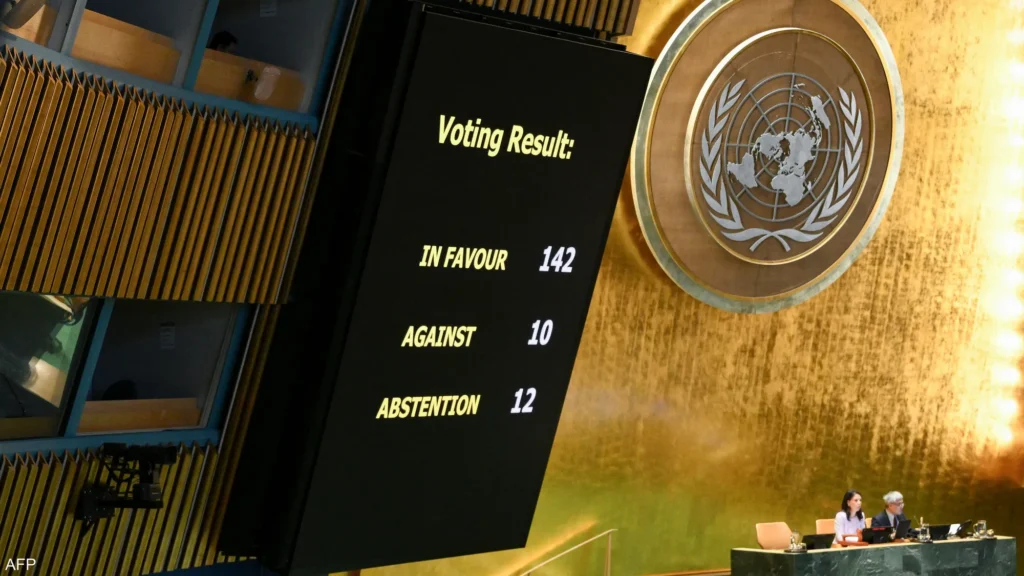
On 12 September, the United Nations General Assembly debated and adopted what is now known as the New York Declaration in support of a two-state solution to the Israeli–Palestinian conflict.
While the resolution won overwhelming support — 142 countries voted in favour, 10 opposed, and 12 abstained — the absence of several prominent Arab and Muslim-majority countries from the vote surprised many observers.
Unusual Voting Pattern
Among those not participating were Iraq, Tunisia, Iran, Cameroon, Albania, South Sudan, and Ethiopia. Their absence came even as some Western countries traditionally viewed as close to Israel supported the declaration.
This unusual voting pattern highlights the complex political and regional calculations that shape positions on the Palestinian issue today.
Why Some Countries Chose to Stay Away
According to diplomats and analysts, the absences were not simply acts of indifference.
Many of these states face intense domestic pressures, internal political rivalries, or delicate negotiations with other powers.
For example, Iraq’s political scene remains deeply divided among factions with differing foreign-policy priorities, while Tunisia has alternated between strong pro-Palestine stances and cautious abstentions in recent UN votes.
Iran Absence
Iran’s absence was particularly striking.
Tehran has repeatedly voiced support for what it calls “resistance factions” in Gaza and rejects labelling them as “terrorist organisations.”
For Iran, endorsing a two-state solution risks being seen as an implicit recognition of Israel — something at odds with its longstanding policy.
Analysts cited by British media suggested that Iran’s silence could also be tied to ongoing negotiations with Saudi Arabia and France, both key sponsors of the New York Declaration.
Contentious Provisions Inside the New York Declaration
At the heart of the declaration are clauses condemning 7 October 2023 Hamas attacks and calling for the end of Hamas’s control over Gaza, the surrender of its weapons, and its exclusion from any future Palestinian government.
Supporters argue these conditions are necessary to restart a credible peace process.
However, critics see them as unrealistic and potentially destabilizing, given Hamas’s entrenched presence and influence in Gaza.
The declaration also stresses adherence to international law: halting attacks on civilians, rejecting all forms of terrorism, banning forced displacement, and opposing any changes to Palestinian geography or demographics through settlement expansion or annexation.
In this sense, it simultaneously condemns both Hamas’s attacks and Israel’s military actions, siege, and destruction of infrastructure in Gaza — signaling that war and occupation cannot be paths to peace.
Mixed Signals From Global Powers
The United States openly opposed the New York Declaration, calling it a “free gift to Hamas” that could derail diplomatic efforts.
Washington’s position indirectly influenced countries dependent on U.S. support.
For instance, Cameroon and Albania — both with security or economic ties to the U.S. — opted to abstain or be absent from the vote.
By contrast, most Arab states endorsed the declaration, led by Saudi Arabia, which played a major role in advancing the text.
French President Emmanuel Macron welcomed the initiative, saying Paris and Riyadh were working on an “irreversible path” to peace.
The planned international conference on 22 September is expected to translate the declaration’s principles into practical steps.
Peace in Exchange for Concessions
Over decades, global support for a Palestinian state has grown, but often with the condition that Hamas be excluded from the political equation.
This mirrors 2002 Arab Peace Initiative and numerous UN resolutions calling for a Palestinian state within the 1967 borders with East Jerusalem as its capital.
This separation — recognizing Palestinian rights while rejecting Hamas’s role — has become a central feature of many governments’ positions.
Combined with the ongoing Palestinian political split and differing Arab and Muslim stances, it makes crafting balanced and fair resolutions a daunting task.
Yet the New York Declaration signals renewed international momentum.
By embedding the two-state solution in a framework that condemns both terrorism and collective punishment, it offers a potential roadmap for de-escalation.
Whether that roadmap succeeds depends not only on Israeli and Palestinian leaders but also on the ability of regional and global powers to align their strategies and support a unified diplomatic track.
A Complex but Crucial Moment
The mixed reactions to New York Declaration underscore how deeply intertwined domestic politics, regional rivalries, and international diplomacy have become in shaping the Israeli–Palestinian conflict.
While the declaration may not satisfy all parties, its overwhelming support suggests that the principle of a two-state solution still commands broad global backing.
For countries that stayed away, their silence speaks volumes about the pressures and trade-offs they face. For those that supported it, especially Saudi Arabia and other Arab states, it reflects an effort to move from rhetoric to action in pursuit of a durable peace in the Middle East.