



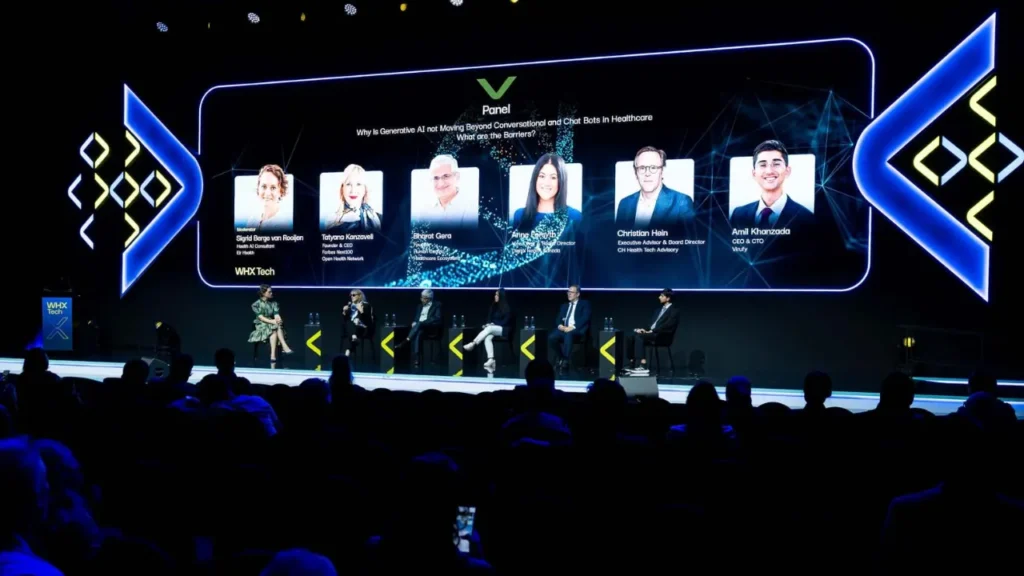
Generative AI may be the fastest-adopted technology in history, but in healthcare it is still often viewed through the limited lens of chatbots.
At the WHX Tech-EHS Summit in Dubai, experts warned that this perception risks blinding policymakers and providers to the deeper potential of Generative AI—and to the barriers standing in its way.
“It’s like saying the internet is only e-mail,” said Christian Hein, former Novartis vice-president for digital transformation.
“Chatbots are just the front-end.
The real power lies beneath—an information engine capable of synthesising scientific literature, drafting clinical trial protocols, automating reimbursement coding and extracting unstructured data from medical records.”
Rethinking Health Workflows
The discussion, moderated by health AI consultant Sigrid Berge van Rooijen, began with a provocative question: Is generative AI destined to remain a glorified customer-service tool?
For Tatyana Kanzaveli, founder of Open Health Network, the danger lies in bolting new technologies onto outdated systems.
She sketched a different future: “Imagine agentive AI predicting when MRI equipment is about to fail, ordering the part, scheduling the engineer and coordinating the fix automatically.
Or a digital twin monitoring your health data, arranging prescriptions, transport and care without you lifting a finger. That is the world we should be building.”
Read also: Impacts of AI on Job Market and the Ways to Deal with This Huge Transformation
Healthcare is Fundamentally Human
Bharat Gera, a veteran of digital health transformation, agreed that GenAI holds promise but urged caution.
Summarization of patient histories, he said, is a powerful use case “here and now,” but clinicians must not be overloaded with alarms or unvalidated signals.
“Healthcare is fundamentally human.
If we forget that, technology will make things worse.”
Regulation, Risk and Responsibility
While technology races ahead, regulation lags behind.
Amil Khanzada, CEO of Virufy, highlighted how data laws differ dramatically between countries.
“In Dubai, anonymised medical data cannot be sent overseas.
In Pakistan, there isn’t even a privacy law yet.
Patients have the right to delete their data, but what happens once that data has already trained a model? Do you retrain it from scratch?”
Legal and Ethical Risks
Consent forms are another challenge.
“You can try to use generative AI to summarize them, but you still need human validation.
And patients often sign without reading.
The legal and ethical risks are enormous,” Khanzada warned.
Kanzaveli added that misplaced trust can be deadly.
“Generative AI is persuasive.
You trust it. But in healthcare, a wrong answer can mean a missed diagnosis.
We spent longer building the risk-management framework for a virtual psychologist than we did building the engine itself.
That is our responsibility.”
The Human Factor
Anne Forsyth, Vice-Chair of Digital Health Canada and IT lead at Toronto’s Women’s College Hospital, offered a sobering example of why planning for failure matters.
She described how a cancer diagnosis was delayed for a year because test results were stuck in a hospital IT interface.
“Tech will never be perfect.
We must always plan for failure.
If you’re building Generative AI tools for hospitals, think about what happens when they fail, and what supports clinicians will have.”
Hein agreed. “Technology is easy. Change is the hard part.
The real work is persuading people that you are there to augment, not replace them.
Without that, AI will never scale.”
A Future Too Important to Ignore
Despite their differing emphases, the panellists agreed that generative AI is already reshaping healthcare and that ignoring it is not an option.
“There is no industry that can remain competitive without deploying these technologies,” Kanzaveli said. “The only question is how responsibly we do it.”
As Berge van Rooijen concluded, the challenge is no longer whether GenAI is more than a chatbot—it clearly is.
The real task is to harness its promise responsibly, avoiding the mistakes of past digital health revolutions and keeping patients at the centre of the system.
Source: World Health Expo