


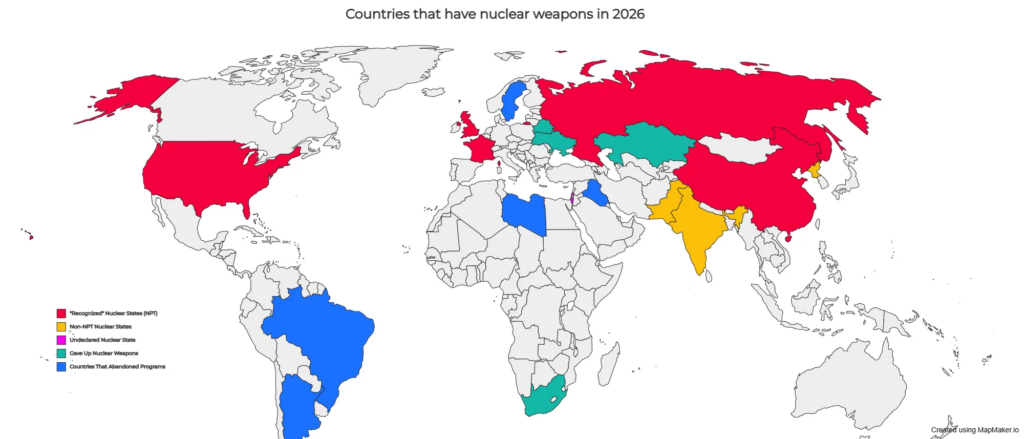
Global nuclear stockpile numbers are the focus of a lot of worry right now because the big treaties that used to keep a lid on these weapons are starting to expire this year in 2026. For a long time, we felt a bit safer because the United States and Russia were talking to each other and counting their missiles, but that relationship has become very cold lately. When you ask who has the most weapons, the answer is still Russia, which holds a total global nuclear Weapons of about 5,459 warheads according to the latest data from early this year. The United States is right behind them with over 5,100 weapons of their own, and together these two countries own almost 90% of all the nukes on the planet. This global nuclear Weapons is so large that it could destroy the world many times over, which is why everyone is so nervous about the “New START” treaty ending on February 5, 2026, without a new deal to replace it.
Read Also: Global Oil Crisis: Governments Race to Limit Iran War Impact
The Dangerous Growth of the Global Nuclear Stockpile in Asia
While the two big giants are holding onto their old bombs, the global nuclear Weapons is actually growing the fastest in China, where they are building new silos at a very high speed. Just a few years ago China had around 350 warheads, but now their part of the global nuclear Weapons has reached 600, and some experts think they will have 1,000 by 2030. This change is making the balance of power in the world very shaky because we are moving from a two-way race to a three-way race between the US, Russia, and China. Other countries like India and Pakistan are also adding to the global nuclear Weapons every year as they try to keep up with each other in their own local rivalry. Even though the total number of bombs in the world is much lower than it was during the Cold War, the fact that the global nuclear Weapons is spreading to more countries makes the situation more complicated and harder to manage.

Why Russia Leads the Global Nuclear Stockpile Today
The reason Russia has the largest global nuclear Weapons is partly because they kept many of their smaller “tactical” weapons that were made to be used on a battlefield rather than on a whole city. While the US focused on big missiles that stay on submarines or in underground pits, Russia invested in a wider variety of ways to deliver their part of the global nuclear Weapons. Because they feel a lot of pressure from the West, Russia sees their global nuclear Weapons as their “insurance policy” to make sure no one tries to invade their land. Even though many of these warheads are old and waiting to be taken apart, they still count toward the total global nuclear Weapons inventory that makes people stay awake at night. It is a very expensive and dangerous hobby to have, but for the leaders in Moscow, their global nuclear Weapons is the only thing that keeps them at the same table as the Americans.
Read Also: Iran Internet Blackout: Offline Communication Methods
The Problem of Tracking the Global Nuclear Stockpile Without Treaties
For decades, we had inspectors who would fly to different bases and actually count the missiles to make sure no one was cheating on the global nuclear Weapons limits. But this year in February 2026, the last big agreement called New START expired, and now we don’t have those eyes on the ground anymore. This means that the numbers we have for the global nuclear stockpile are mostly just good guesses based on satellite pictures and what the governments choose to tell us. Without these rules, there is a big risk that countries will start a new race to see who can have the biggest global nuclear stockpile again, which would waste a lot of money that could be used for schools or hospitals. The global nuclear stockpile is most dangerous when it is a secret because then every country assumes the other side has more and they start building even faster out of fear.

Read Also: Fake face study: can we still tell what’s real?
Final Thoughts on a World with Atomic Weapons
We have to realize that the global nuclear stockpile is a reality of the modern world that we cannot just wish away overnight. It takes a lot of hard work from diplomats and regular people to push for peace and to make sure these weapons are never used again like they were in 1945. The global nuclear stockpile should remind us that we are all living on the same small planet and that a big war would leave no winners at all. We must hope that the leaders of the nuclear nations can find a way to start talking again and agree to lower the global nuclear stockpile for the sake of our children. Knowledge and talking are the only real shields we have against the power of the atom.